Showing posts with label Market Commentary. Show all posts

Wednesday, June 30, 2010

Investment in stocks NOT a must for a complete and balanced portfolio

The Economic Times reports today

Investment in stocks must for a complete and balanced portfolio
'If you really want your money to grow - stocks is the only way to go'- Haven't you heard this umpteen times. Well, it holds true every time.

As compared to fixed deposits, investments in equity will pay 26.5 per cent higher returns in 5 years. Even for a longer term, investment in stocks pay higher returns even in comparison to real estate and gold. 
Investments in equity WILL? pay 26.5% higher returns in 5 years? Well there you have it... Economic Times India writers know exactly what equity market returns will be in 5 years.  And if they know what equities are going to do, why are they writing newspaper articles, they should be hedge fund managers.


They trot out Infosys and Tata Steels.  Tata Steels share price performance is shown above.  What if you were unfortunate enough to have bought tin 2006 and sold in fear in 2009? You would have a significant loss!

That is the issue that unsuspecting investors in India are learning for themselves.  Stop listening to the mutual fund industry marketing buzz and start being wise investors.

There is a time to buy equities and when that time comes, I will invest agressively.  Today is not that time.
Success in the markets requires patience and waiting for the fat pitch.  Investors entering the market today are likely going to be disappointed as opposed to investing in secure investments.

Thursday, November 19, 2009

Dell Lays An Turd -- What? Businesses are not spending?

Revenues down from last year, losing market share to Acer, profits down 54% from last year.

Expectations were priced in that Dell would beat, so the earnings ugliness is a surprise to the green shooters.

Dell reported a net profit of $337 million, or 17 cents a share, for its fiscal third quarter, down from $727 million, or 37 cents a share, in the year-ago period.
Revenue fell 15 percent to $12.9 billion, missing the average analyst estimate of $13.2 billion, according to Thomson Reuters I/B/E/S.
While the revenue shortfall was troubling, some analysts also expressed concern about Dell's margins, particularly because the company had stressed profitability over growth amid a $4 billion cost-cutting effort.
Dell, which relies primarily on sales of PCs to businesses, has suffered as companies dialed back spending during the economic downturn. Acer and HP have also been waging a price war, analysts say, particularly in consumer laptops.
 But weren't consumers the ones that were holding back the recovery? Now  businesses are unwilling to spend?  Huh, What A Surprise (sarcasm)

This will likely have a impact early in the morning, and I will look to take immediate profits on the shorts added this afternoon, and exit additional positions as the selling slows down.

It looks to be a good idea to have added shorts at the close.

Finerman Does Not Get Gold, Paulson Launches Gold Fund

Finerman? on the Fast Money show does not understand. Gold isn't necessarily just an inflation trade as Finerman believes.  She is afraid of Gold "look out below" on inflation expectations.  She is clueless.

Gold does well in environments when fiat money is being abused and vulnerable and being debased.  Can we say with certainty that is exactly what is happening in the U.S., Japan, Europe and China, yes, China?  The answer in my opinion is definitively Yes.

Meanwhile Paulson, billionaire hedge manager, is launching a gold fund.

I should not have sold my miners earlier.  I am now scaling in very gradually into Gold miners.
A great site to learn about gold stocks is Gold Versus Paper

Saturday, November 14, 2009

What Could Possibly Go Wrong With the Recovery?

Debt
Just one month into the 2010 fiscal year, the U.S. government is on track for a record $2 trillion annual budget deficit.  That’s the word from the Treasury Department, which quietly announced a $176.4 billion October budget deficit yesterday.

The U.S. government finished its historic streak of debt sales today with a record $16 billion offering of 30-year bonds, auction results on the weak side. This was on top the $65 billion in 3-year and 10-year paper auctioned earlier this week, both records in their own right.

“The market is sending many errant signals right now,” notes Dan Amoss. “U.S. policymakers are trying to reinflate stocks, houses and wages, while also recapitalizing an undercapitalized banking system with overt and covert subsidies. All of these actions are extraordinarily costly — so costly that creditors are getting nervous.

“A failed auction for U.S. Treasuries, looking out over the next couple of years, is not out of the question. 

If this happens, conditions in the interest rate derivative market, with a notional value in the hundreds of trillions of dollars, could get ugly fast.

The question then becomes: who bails out the federal government? The Fed’s printing press could be cranked into overdrive, but if holders of dollars look to get rid of them as quickly as they’re created, this sort of policy route will losing its potency over time.

The U.S. is not Japan, We are Worse
the US economy is not exactly like the Japanese economy. Japan had high savings…and a positive trade balance. It could run up huge government debts and “owe it to itself.” It could finance its government debts with the savings of its own people, in other words. It never had to worry about foreigners refusing to buy its bonds…or selling them suddenly.

America’s government debt is different. The US doesn’t save enough to finance its own deficits. So it depends on the kindness of strangers. And if those strangers ever lose faith in America’s ability or willingness to repay its debts, they’ll drop the dollar like an annoying girlfriend. 

FHA Cash Reserves At All Time Low
The Federal Housing Administration said Thursday morning that its cash reserves had dwindled significantly in the last year after a record drop in home prices.

The results of the F.H.A.’s annual audit showed the agency’s capital reserves to be 0.53 percent, far under the 2 percent minimum mandated by Congress. A year ago, the capital reserves were 3 percent.

It is tightening loan standards in hopes it will not become another drain on the United States Treasury, but is reluctant to clamp down so much that it snuffs out the tentative recovery in housing.

During the news conference, Secretary Donovan and the agency’s commissioner, David H. Stevens, said that the cash reserve, the figure that has fallen to 0.53 percent of loans outstanding, was merely a supplement to a much larger fund that the F.H.A. was holding against expected losses. Between the two accounts, the agency has $31 billion to cover losses over the next 30 years.
Barofsky Says TARP ‘Almost Certainly’ Will Bring Loss to U.S.

New Mortgage Applications Plummet
Housing demand is not sustainable. Applications for new mortgages, announced Thursday morning, dropped sharply in the previous week to levels not seen in almost a decade. This decline was consistent with Toll Brothers' (TOL Quote) conference call on Wednesday, in which the company's Chairman described demand since Labor Day as uneven.

I don't see what replaces housing as a driver to growth -- the sector was responsible for over 40% of job growth in the 2001-2007 period.

IEA Says Rising Oil Price Risks Derailing Economic Recovery
The International Energy Agency Thursday revised it 2010 world oil demand forecast slightly higher, but warned that rising crude prices, if sustained, risk smothering the fragile economic recovery underway.

Dollar Dying
We have a Federal Reserve and Treasury which have agreed to double team the ailing dollar as they print money to no end and effectively punish the prudent while rewarding the speculators (the same bastards that helped create this mess to begin with).  Our tax issues have not yet reared their ugly head, but trust me, they are coming.

Massive Govt Revenue Shortfalls
What we haven’t quite dealt with is how the government is going to overcome their massive revenue shortfalls and ever expanding debt.  As Jim Jubak recently described, they are going to come back to the consumer for another blow to the knees.  No, the bailouts weren’t enough.  Destroying the dollars in your pockets isn’t enough. Because of their fiscal irresponsibility they are going to raise your taxes in 2010.  And don’t be fooled.  The income tax may not spike, but they will get you in every other way they can. Sales tax, real estate taxes, etc etc. You are paying for their mistakes. Whether you were prudent or not.

Municipalities are in financial disarray and won't provide their normal anchor to growth - 10 states face financial peril
Dropping tax revenue, rising unemployment and yawning budget gaps are wreaking havoc in states from Arizona to Wisconsin, a new report shows. The 10 most troubled states are: Arizona, California, Florida, Illinois, Michigan, Nevada, New Jersey, Oregon, Rhode Island and Wisconsin.

Other states -- including Colorado, Georgia, Kentucky, New York and Hawaii -- were not far behind.

Already, less than five months into fiscal 2010, several states are looking at additional budget cuts.

And in California, Gov. Arnold Schwarzenegger said Tuesday that his state is facing a budget gap of up to $7 billion.  Budget projections show that states could face deficits as large as $260 billion in 2011 and 2012 after stimulus funding is exhausted. State economies usually take up to two years longer to recover after the nation's fiscal health begins to improve.

Yet More Bubbles & A Warning from Donald Tsang

The Federal Reserve’s policy of keeping interest rates near zero is fueling a wave of speculative capital that may cause the next global crisis, Hong Kong’s leader said.

“I’m scared and leaders should look out,” said Donald Tsang, chief executive of the city, said in Singapore today. “America is doing exactly what Japan did last time,” he said, adding that Japan’s zero interest rate policy contributed to the 1997 Asian financial crisis and U.S. mortgage meltdown…

“We have a U.S. dollar carry trade at the moment,” Tsang, 65, said in a speech where leaders of the Asia Pacific Economic Cooperation forum are gathering for a weekend summit. The carry trade is where investors borrow cheaply in one currency and use the funds to invest in other currencies.

“Where is the money going — it’s where the problem’s going to be: Asia,” Tsang said. “You can see asset prices going up, not only in Korea, in Taiwan, in Singapore and in Hong Kong, going up to levels that are incompatible or inconsistent with the economic fundamentals.”

A sampling of recent inflationary developments
* A 15 percent increase in health insurance premiums for small businesses

* A 50 percent increase in car rental costs

* A 15 – 25 percent increase in long-term care insurance rates for California retirees

What Could Possibly Go Wrong? S&P 1200 here we come

Thursday, November 5, 2009

There Is Usually A Simple Explanation

Trader involved in insider trading worked at SAC Capital

I was at a large bank on Wall Street back in the Nasdaq heyday.  The internet analyst at our firm was Holly Becker and she was an axe on Internet stocks along with some others, Meeker, Blodget etc.

It was found out back then that Holly Becker had been feeding her calls pre-release  to her husband, who happened to work at SAC Capital.  Holly resigned, no prosecutions were made.  I found it unbelievable.  Such is the world that is Wall Street.

The point I want to make is that in the vast majority of cases of significant outperformance, there is usually a very simple explanation.  Our culture has no moral hazard.  Sports, Business, Politics.  Fame, fortune and power trump morals.  Period.

Sunday, November 1, 2009

China : When the Driver of the World Economy Is A Speculative, Drunk, Riverboat Gambler

It is our opinion that China today is circa Japan in the late 1980s when it was a manufacturing powerhouse and seemed poise to continue its rise to superpower and world domination.
Jim Grant, Grants Interest Rate Observer: 


China today is where Japan was in the late ’80s, except with the greater political instability that comes with a semi-controlled economy and the lack of a social safety net (read: jobless, hungry people don’t write angry letters, they riot)…Today China projects to the world a similar image as Japan did in the 1980s… “


Richard Bernstein, former chief investment strategist at Merrill Lynch, says China’s economy is overheating and that investors should avoid its stock market. “China is an immense credit bubble that's going on right now,” he tells CNBC.   "They have massive overcapacity and their solution to that problem was to build more capacity over that," says Bernstein, now CEO of Bernstein Capital Management.
 “A superb primer on the risks of China’s go-for-broke lending drive was published by Fitch Ratings on May 20. Is it not passing strange, the agency asks, that Chinese lending is accelerating even as Chinese corporate profits are shrinking? ‘Ordinarily, falling corporate earnings are met with tightened lending, but in China, precisely the reverse is evident. . . .’ You would expect—and Fitch does anticipate—that the borrowers of these trillions of renminbi are not so profitable as they were in the boom, and some will therefore struggle to service their debts.”


Lately, the Chinese economy has been impressing us with its growth…But Chinese economic structure is not is not superior to the West’s; the Chinese can just cook GDP numbers better and control their economy more effectively through forced lending and spending.
However, these short-term advantages come with long-term consequences – there will be a steep price to pay for them; there always is. 


“Examining, first, the track of Chinese bank lending and, second, the trend in Chinese nonperforming loans, the seasoned reader will remember … Drexel Burnham Lambert. In the mid-to-late 1980s, the American junk bond market combined breakneck growth with muted default rates. The secret, fully revealed during the subsequent bear market, was that the default rates were a direct product of the issuance rates. Borrowers didn’t default because of—to adapt the Fitch formulation to that earlier time—the ‘pervasive rolling over and maturity extension of bonds as they fell due.’ Drexel failed when the junk market did.


“Since 2005, China has generated 73% of the global growth in oil consumption and 77% of the global growth in coal consumption.


Today, Chinese economic growth is the force pushing the global economy and stock markets. The quality of this growth, however, is low as it is predicated on massive (forced) lending and is unsustainable. As and when Chinese growth finally slows, the impact will be felt in many, often unsuspected places.


We believe that China’s pulling in the reins will impact commodity markets, commodity producers and commodity exporting nations. Combined with our expectation of deflation in the intermediate term, this will severely impact commodities.  Let’s take oil, for instance. As incremental demand from China slows, oil prices will suffer and impact the Russian economy in particular.  China accounts for 15% of Brazil’s exports (up from 1.5% a decade ago), significantly impacting the economy of that South American nation.


Finally, we are bearish on China because of the enormous amount of overcapacity that currently exists in the country.  China’s manufacturing capacity was structured for a leveraged U.S. consumer and a leveraged world.  As the world delevers, China as the exporting nation faces a difficult transition given it’s excess capacity.  Like the U.S., it is desperately attempting to reflate its economy and continue growth is because it sees the difficult adjustment that lies ahead.   


Thursday, October 29, 2009

Indian Stock Market : Oswal Cautions Indian Investors

 Interesting to see some high profile investors are starting to issue warning signals on the Indian markets.  Local Indian participants are blaming this on the RBI's decision to start tightening, but regardless of what the majority of Indian investors may believe, the Indian market remains a leveraged play on U.S. equities.  The selloff in global markets originated in the U.S. and made it's way over to Asian markets.  Despite conventional wisdom, Indian equity markets continue to be coupled with the global economy.

Indian equity markets may see a sharp fall any time soon as corporate earnings fail to match up to the investors' expectations, making shares increasingly expensive for buyers, Motilal Oswal, Chairman and Managing Director of Motilal Oswal Financial Services Ltd, said.

Oswal said two of the biggest concerns for inventors in Indian stock market are the government's fiscal deficit and a likely flare-up in wholesale price inflation.

Fiscal deficit, the difference between the government's total spending and revenues, is expected at 6.8% of the gross domestic product for the current year. The government was committed to bringing down its fiscal deficit to 3% of GDP by 2008-09, but ended the year with a deficit of 6%. Aggressive spending to their economies, even as revenues plummeted, has led to yawning fiscal gap in most countries.

A high fiscal deficit would mean that the government makes greater provisioning in budget for debt servicing, instead of spending on physical and social infrastructure. Increased market borrowings by the government to bridge the deficit can lead to credit squeeze and put pressure on interest rates.

"Inflation is a big concern for the market. We think it (wholesale price inflation) will cross 5-6% by early 2010. Whenever inflation sustains at these levels, market usually tanks," Oswal said. "That will be the time when the government may start rolling back the stimulus," he said. The government has said the economic and fiscal stimulus given in the past year will continue at least until the end of the current year.

Wednesday, October 28, 2009

Ten Reasons This Market Has Peaked Or Close to Peaking

Even though I'm not a technician by trade, I must begin with technicals because fundamentals have not driven this market rally.  In my opinion, this has been a speculative, technical bounce similar to past rallies off severely oversold conditions especially involving the Fed and loose monetary policy.

Technicals - Time Price & Pattern Coinciding Suggest A Major Trend Change Is Imminent

The prevailing consensus is that Elliott Wave Theory is for crackpots and cannot be used profitably.  Most analysts would agree with that opinion.

However, Elliot Wave (EW) was one of the few technical analyses to predict that the market would have a tremendous rally from the lows.  Not only that we were able to exit the market at 682 based on a clearly identifiable pattern completion.  While the consensus on EW is that it's a tough strategy to make money with, I'd point out that EW was used by legendary investors like Paul Tudor Jones to forecast and profit from the 1987 crash.  More recently, Robert Prechter gained fame with an 800 point forecast shorting the S&P at the top and exiting at 720.

Most particularly, EW is at its most reliable when three factors - time, price and pattern - coincide.  At these times, trend change is inevitable.  Time will tell obviously as these are interesting times we live in.

1. Time - From October 2007, the S&P has completed a 38% time retrace and will complete a 50% time retrace on November 17th
2. Price - From Octoer 2007, the S&P has completed a 38% price retrace from the March lows and is nearing a 50% price retrace at 1117
3. Pattern - Since the March Lows, the S&P has completed an ABC corrective pattern

In our opinion, EW is forecasting that we are near completion of a multi month trend and an imminent change in direction is coming.


4. October 2007 Trendline Rejection & 5. March 2009 Trendline Break

As you can hopefully see from the chart above, the March 2009 trendline was convincingly broken today.  In addition, the S&P 500 was repelled convincingly from a major trend line (Oct 07 to Apr 08) and the volume on the selloff has been larger than in recent weeks.  The selloff has also been impulsive, again a strong indicator that we could be in for a change in market character.  We remain bearish until the market can convincingly pierce through the major trendline.

Fundamentals
6. Valuation - Analyst estimates for 2010 are overly optimistic


Q3 Earnings for the S&P are currently estimated by Standard & Poors to be around $14.78.  This translates to a negative year over year growth of -7.41% versus Q3 of 2008.  Now do I need to remind you of where we were in Q3 2008?  Does the collapse of Lehman serve as an appropriate benchmark?  And even after all the handouts, bailouts, tarp buybacks, and a 50% rally, the S&P 500 hasn't been able to show year over year growth versus a very "easy comparable".

But Wall Street's prescient analysts are forecasting the S&P will grow earnings by 34% in 2010, Consumer Discretionary will grow 58%, Energy 89%, Financials 137%, Tech 30% and Materials by 94%!

We've seen this same story since March 2008.  Analysts are overly optimistic.  On trailing earnings, using the generous operating earnings measure, the S&P is still at a very pricey 26 times earnings.


7. The Debt Piper Will Need to Be Paid - Julian Robertson, Tiger Capital

What most Wall Street investors are conveniently forgetting is that the U.S. government's bandaid approach to handling crises has created debts that will stay with us at best for a long long time and at worst send us the way that Japan is headed.  David Einhorn of Greenlight Capital illustrates it far better than I could:

Japan appears vulnerable, because it is even more indebted and its poor demographics are a decade ahead of ours. Japan may already be past the point of no return. When a country cannot reduce its ratio of debt to GDP over any time horizon, it means it can only refinance, but can never repay its debts. Japan has about 190% debt-to-GDP financed at an average cost of less than 2%. Even with the benefit of cheap financing the Japanese deficit is expected to be 10% of GDP this year. At some point, as American homeowners with teaser interest rates have learned, when the market refuses to refinance at cheap rates, problems quickly emerge. Imagine the fiscal impact of the market resetting Japanese borrowing costs to 5%.

Over the last few years, Japanese savers have been willing to finance their government deficit. However, with Japan’s population aging, it’s likely that the domestic savers will  begin using those savings to fund their retirements. The newly elected DPJ party that favors domestic consumption might speed up this development. Should the market re-price Japanese credit risk, it is hard to see how Japan could avoid a government default or hyperinflationary currency death spiral...

For years, the discussion has been that U.S. deficit spending will pass the costs onto “our grandchildren.” I believe that this is no longer the case and that the consequences will be seen during the lifetime of the leaders who have pursued short-term popularity over our solvency. The recent economic crisis and our response has brought forward the eventual reconciliation into a window that is near enough that it makes sense for investors to buy some insurance to protect themselves from a possible systemic event. To slightly modify Alexis de Tocqueville: Events can move from the impossible to the inevitable without ever stopping at the probable. As investors, we can’t change the course of events, but we can attempt to protect capital in the face of foreseeable risks.


8. The Economic Landscape Has Not Confirmed the Market's Rally

I won't bore you with the details but there is hardly any evidence of an economic recovery.  Most of the earnings beats have been due to cost cutting and playing the Wall Street game of earnings beating "forecasts".
  • Declining & downright scary Consumer Confidence numbers the past two months
  • Cost cutting to generate earnings today will have impacts in future quarters
  • While unemployment is a lagging indicator, jobless claims are coincident and the continued stubborn plus 500k levels of jobless claims each month the past few months are going to have structural impacts in the coming months

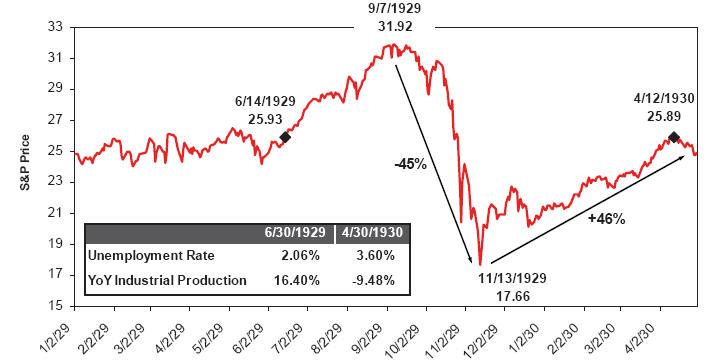
9. This rally is more likely a dead cat bounce similar to 1929-30

Source: GMO

The idea of significant rallies off severely oversold bear markets is not new.  After the sharp decline in the fall of 1929, the S&P 500 rallied 46% from its low in November to the rally high of April 12, 1930. Economic commentary from those days suggested that participants were convinced a new bull market was underway.  What followed to the horror of overly optimistic participants was a gut wrenching 80% decline.

10. The Option ARM crisis is real (2010), Commercial Real Estate is real (Capmark), the States Crises is real & the Consumer Is Spent

Stock markets usually lead the economy by 6 to 9 months.  It's usually around this time that the economy starts delivering solid economic data.  But when you see news items like Citibank raising credit card rates to 29.9% for all clients, you know that all is not well, not with the banks and not with the consumer.

We have yet to see significant improvements to justify the 56% market rebound that we have seen off the lows, so in our view the risks are now clearly to the downside.  Market participants are starting to recognize this and stocks that are beating estimates are selling off. 

One obvious caveat to our forecast is the Fed.  The Fed, the Treasury and US government are committed to pulling out all stops to pull the US out of the Great Recession.  But unless new programs are used to address the underlying problems that ail the economy, they are likely to be short term fixes.  Further, the action in the dollar and other market action is sending signals that the U.S. will need to be very careful in announcing new programs.